

















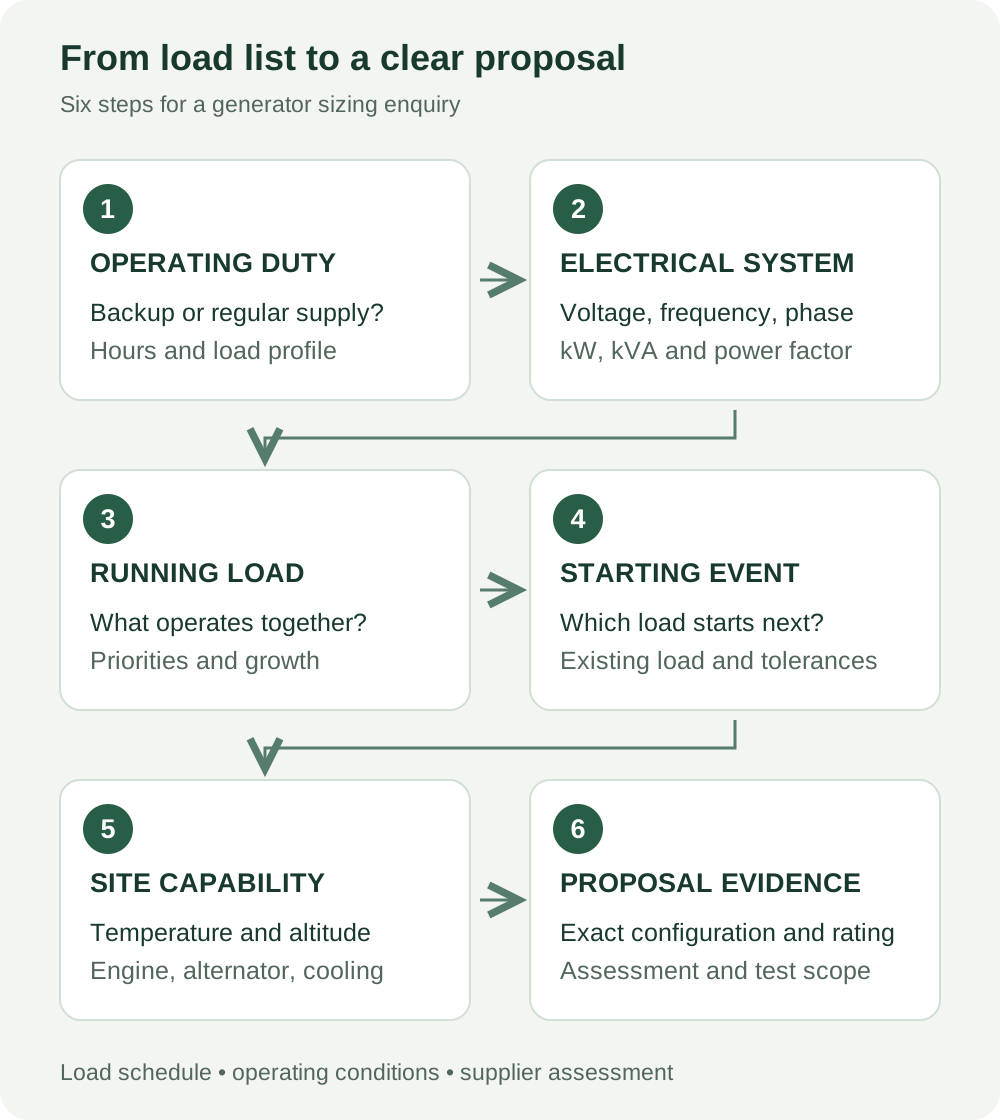
The load schedule is the starting point. It should show what runs together, what starts next and the electrical conditions the equipment can tolerate. With that information, suppliers can explain their recommendation and project teams can compare quotations on the same basis.
1. Match the power rating to the operating duty
First, describe the job the generator will do. Will it supply the facility during utility outages, provide electricity regularly, or carry a constant load? State the expected operating hours and daily load pattern. For backup applications, identify the equipment that must remain available during an outage and how it will be brought back online.
The rating beside the quoted output must suit that duty. A large standby figure can look attractive on a comparison sheet while telling you little about suitability for regular operation.
| Rating commonly encountered | Operating task to clarify with the supplier |
|---|---|
| Emergency Standby Power, ESP | Backup when the normal source is interrupted, within the manufacturer's stated operating limits |
| Prime Power, PRP | A variable-load operating task, subject to the manufacturer's load-profile, service and other rating conditions |
| Continuous Power, COP | A constant-load operating task under the declared continuous-rating conditions |
Ask the supplier to state the rating code, applicable standard edition and operating restrictions. Check any average-load limits and overload allowances against the manufacturer's declaration. An average-load restriction, for example, does not establish a minimum operating target. Cummins' explanation of generator set ratings covers these distinctions.
Keep the duty and rating beside each output when comparing proposals. This allows the project team to compare capacity on the same basis.
2. Read kW, kVA and power factor together
Electrical kW measures active power. kVA measures apparent power, with power factor expressing the relationship between them. When electrical input power and power factor are known:
kVA = electrical input kW ÷ power factor
An 80 kW electrical load at a true power factor of 0.8 therefore draws 100 kVA. That establishes its apparent-power demand; the generator selection still has to account for starting, duty and site conditions. Check the selected set's kW rating and kVA/current limits separately, at the specified duty and site conditions.
Use the load's power factor in this calculation. A generator's rated power factor does not tell you the power factor of every machine connected to it. Likewise, a motor's shaft-output kW and electrical-input kW describe different quantities. Converting shaft output to input requires the motor's efficiency. STAMFORD | AvK's power-factor note explains how active and apparent power relate.
Record voltage, frequency and phase with the demand figures. Where single-phase equipment is supplied from a three-phase system, show its proposed phase allocation and individual currents. The total load may be acceptable while one phase reaches its limit.
3. Build the load schedule around operating scenarios
List the significant equipment, its electrical demand and the operating state represented by each value. A nameplate rating, a measured demand and an estimate should be distinguishable in the worksheet. For estimates, record the assumption and the information needed to confirm it.
| Load-schedule field | Information to provide |
|---|---|
| Equipment and quantity | Pump, compressor, production line, UPS or other identified equipment |
| Electrical demand | Input kW, kVA or current, with voltage and power factor where available |
| Operating state | Normal demand, maximum demand and equipment that actually runs together |
| Starting behaviour | Starting method, current or kVA, acceleration information and sequencing |
| Priority | Loads to retain, defer or shed under the project operating plan |
| Electrical tolerance | Equipment-maker limits and the project's acceptance requirements |
Separate installed capacity from simultaneous demand. If two machines cannot run together, document that operating restriction. If several loads must restart together after an outage, include that condition even when their combined demand is unusual during normal production.
Develop the schedule for a few defined scenarios: normal backup operation, the most demanding required restart and a planned expansion. Check these with the operations and controls teams. Suppliers can then assess the same events, rather than each making a different assumption about how the plant runs.
4. Check motor starting with the other loads already online
A motor's starting demand can be substantially different from its running demand. Collect the starting method, current or kVA, driven load and acceleration information. A single current multiplier will not describe every motor or starting arrangement. Reduced-current starting must also provide the torque the driven machine needs. AGN032 on motor starting methods explains these dependencies.
The sequence matters just as much as the motor data. Starting a pump on an otherwise unloaded generator presents a different event from restarting it with ventilation, controls and process equipment already operating.
Ask the supplier to assess the proposed sequence against the equipment's voltage and frequency tolerances. The assessment should cover initial voltage dip, recovery and engine-speed response. Alternator data alone do not describe the response of the complete generating set; AGN003 on transient performance explains the different stages.
If a proposal depends on sequential starting, confirm the delay and interlocking arrangements with the controls team. The operating plan and the selection need to agree before the generator is ordered.
5. Assess UPS and drive loads at their supply input
For a UPS or variable-speed drive, collect the input characteristics seen by the generator. These include steady and peak input demand, power factor, harmonic characteristics and the equipment manufacturer's operating limits. For a UPS, establish the demand during battery recharge as well as normal operation. For drives, obtain input data for the intended operating and starting conditions.
Keep the measurement boundary consistent. Where a UPS input figure already includes its downstream equipment, enter that figure once. Adding the downstream loads again would count the same demand twice.
Nonlinear loads require an assessment based on the actual equipment and alternator. A blanket oversizing factor cannot settle every application. AGN025 on nonlinear loads discusses the characteristics involved. If input data are missing, list the specific items the equipment supplier needs to provide so the selection can be updated when they arrive.
6. Establish the available output at the site
Give the generator supplier the site altitude and relevant installation temperatures. Outdoor ambient temperature alone may be insufficient: the air entering the alternator can be warmer. The engine, alternator and cooling system each need to be assessed in the proposed installation. AGN012 on environmental rating factors explains the effect of environmental conditions on alternator capability.
Use model-specific data for this review. A universal deduction per degree of temperature or metre of altitude can miss the limits of the actual equipment. Include the proposed canopy or container, filters and ventilation arrangement while the selection is being developed.
The proposal should state the electrical output available from the complete configuration at the specified duty and site conditions. Retain these assumptions with the specification. If the enclosure or ventilation design changes later, the supplier can review the change against the conditions used for selection.
7. Worked example: running load and motor starting
Consider a balanced three-phase supply with a line-to-line voltage of 400 V and the simultaneous loads below. This hypothetical example assumes linear loads with sinusoidal voltage and current. All kW values are electrical inputs, and the two non-unity running power factors are lagging.
| Load | Input kW | Running power factor | Individual running kVA | Reactive power, kvar |
|---|---|---|---|---|
| Resistive process load | 20 | 1.00 | 20.00 | 0.00 |
| Existing process load | 30 | 0.80 | 37.50 | 22.50 |
| Motor load | 15 | 0.80 | 18.75 | 11.25 |
The combined running active power is 65 kW, and the reactive power is 33.75 kvar. Combined apparent power is therefore:
√(65² + 33.75²) = approximately 73.24 kVA
The individual kVA figures add up to 76.25 kVA. Because these loads have different power factors, their apparent powers do not add arithmetically to give the exact combined demand. Sum the active powers and the reactive powers separately, then use those totals to calculate apparent power.
Now assume the motor supplier specifies a starting current of 150 A at a rated line-to-line voltage of 400 V, using balanced three-phase RMS quantities. The corresponding starting apparent power is:
√3 × 400 × 150 ÷ 1,000 = approximately 103.9 kVA
During a generator-fed start, current may change with terminal voltage and motor speed. The rated-voltage figure is an input to the starting assessment, rather than a constant description of the whole acceleration period.
Before the motor starts, the other loads already require 50 kW and 22.5 kvar. Adding 103.9 kVA to 50 kW would mix different quantities. The starting power factor, acceleration time and changing load during the event are still needed to assess the combined demand and generator response.
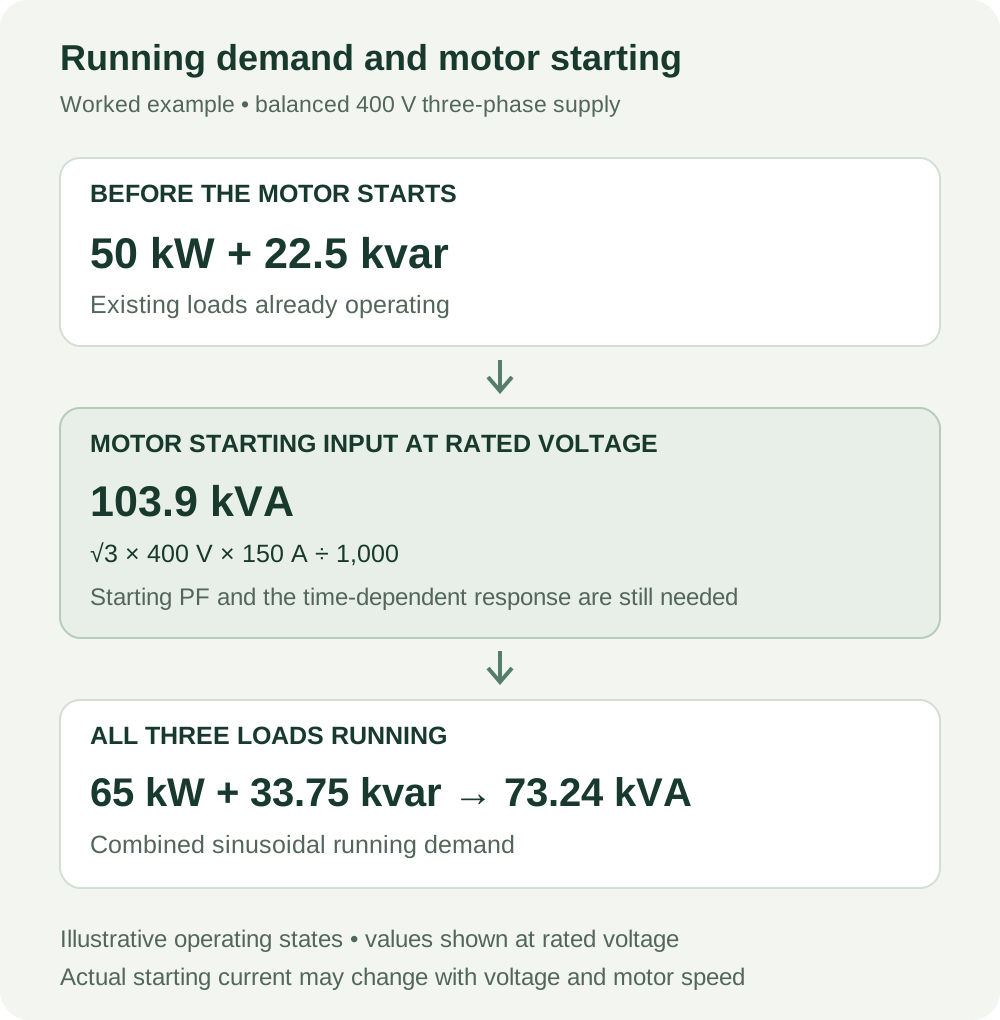
The example establishes running demand and identifies a starting event for review. Selecting a catalogue size requires the supplier to assess that event against the proposed generator's response, the connected equipment's tolerances and the site's available output.
8. Define expansion and redundancy separately
Describe planned growth as equipment and operating scenarios: an additional pump, a second production shift or a scheduled expansion phase. State when it is expected and whether its demand is already included in the worksheet. This keeps the allowance visible when project plans change.
An extra percentage of capacity does not establish starting performance or cover every harmonic and environmental constraint. Each still needs its own assessment. Redundancy raises a further question: what load must remain supplied when one generator is unavailable? Define that requirement and the intended operating arrangement separately from future growth.
Include periods of low demand in the operating profile. Review them against the selected engine and generator-set requirements before increasing the size substantially. The supplier needs to understand the expected everyday load as well as the highest demand.
9. Tie the proposed configuration to the selection
A quotation should identify the engine, alternator and controls, together with the declared duty rating, electrical system and site assumptions. Request the starting or load-step assessment relevant to your load schedule. Agree the test conditions and records needed to confirm the project's requirements, including any assumptions awaiting approval.
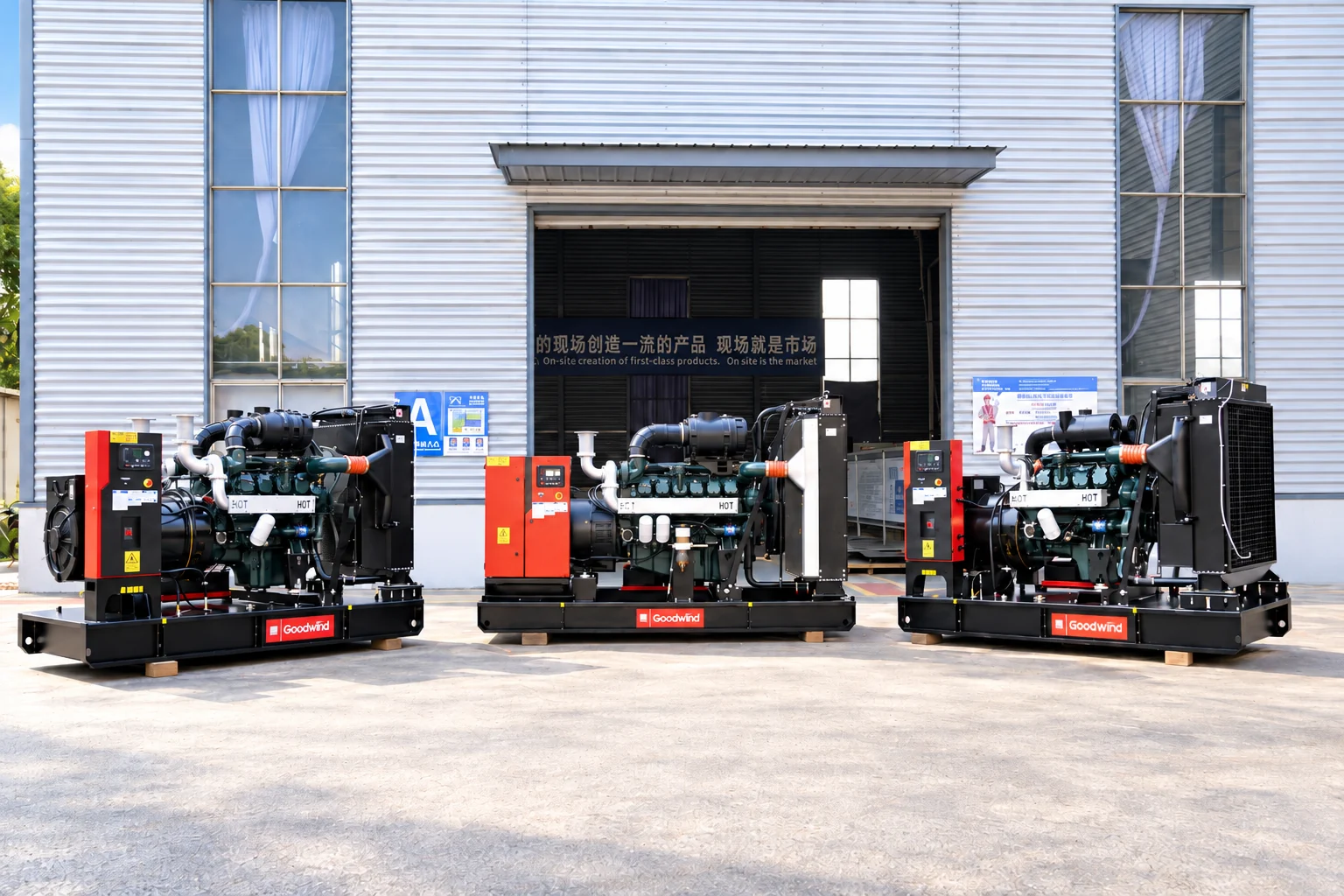
When reviewing GOODWIND's Cummins-powered generator range, match the proposed model and complete configuration to the load schedule. Check the quoted output and performance assessment against the equipment being supplied.
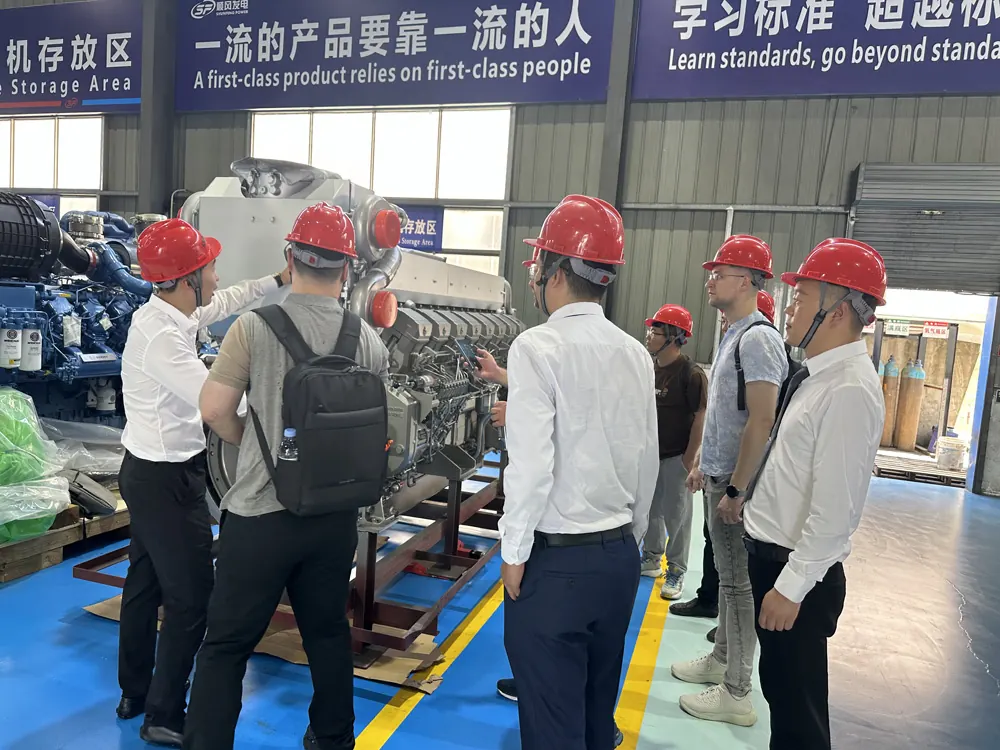
Our manufacturing and quality information describes a test system that records output, load capability and electrical parameters, including dynamic parameters. For your order, agree the required load steps, operating conditions, acceptance criteria and test records during the technical discussion.
10. Send the information needed for selection
Send GOODWIND your application, destination, operating duty, voltage, frequency, phase and load schedule. Include motor-starting information, UPS or drive input data, altitude, temperature and the proposed installation format. Add expansion plans and any requirement to maintain supply when a generator is unavailable.
Share the drawings and equipment-maker data already available, along with the decision deadline. Mark outstanding information so it can be followed up during the technical review. The load schedule, operating sequence and site conditions should all refer to the same project revision.
For a generator selection and quotation, contact GOODWIND with your load and site requirements.
Questions buyers often ask
Can monthly electricity bills be used for sizing?
Monthly kWh measures energy consumed over time. To assess capacity, provide simultaneous demand and starting events. Where available, demand records can support the load schedule and help establish the facility's operating pattern.
Which kW figure should I use for a motor?
Check whether the manufacturer's figure describes shaft output or electrical input. If it is shaft output, obtain the efficiency needed for conversion. Record the basis beside the value so all suppliers use the same input.
How should two quoted capacities be compared?
Compare their operating duty, rating conditions, voltage, frequency and site assumptions first. Then check the configuration and starting assessment against the same load schedule. This explains more than comparing the largest kVA figure on each quotation.