























Holding stock or taking deliveries during an outage
A freezer holding packed goods at their storage temperature has a different job from one taking a delivery that still needs cooling. Opening a loading door adds heat. Bringing warm product down to temperature adds more. A refrigeration schedule may express that duty in kW of cooling. For the generator quote, ask the refrigeration contractor for the electrical input of the compressors, fans and pumps that will deliver it. ASHRAE distinguishes these loads in its chapter on refrigerated-facility design.
Make the operating decision room by room. Can receiving close while the freezer holds existing stock? Does the chilled dispatch room still need its doors open for outgoing orders? Ask the operator for the permitted temperature range, a temperature trend from normal operation and any records from a previous outage. The product, starting temperature, stock level and door traffic all matter. Room volume alone gives us little basis for promising how long cooling can stop.
The circuits behind each cold room
Corning Council for Assistance in New York received funding for an outdoor walk-in refrigerator, an outdoor walk-in freezer and a backup generator. In Fujian, a canteen tender specified one chilled room and one freezer room, complete with electric defrost and high-temperature alarms, but explicitly excluded the incoming 380 V supply from the refrigeration price. When you compare bids, mark who supplies the transfer switch, who connects the refrigeration panel and who proves that each room restarts. New York award record, Southern Tier · Fujian procurement notice, section IV
| Circuit or service | Decision for the owner and contractors |
|---|---|
| Room controller, temperature logger and alarm link | Identify which must remain live through transfer. If the logger has a battery, check whether the gateway or router that sends its alarm also has backup. |
| Refrigeration serving the first room | Identify the compressor and the equipment it needs, including condenser fans or cooling-water pumps, evaporator fans and controls. Mark any shared equipment that must run even if only one room needs cooling. |
| Defrost and heaters | List electric defrost banks separately from door, drain and floor heaters. Ask the refrigeration designer which may wait, for how long, and what releases each one. |
| Loading dock, chargers and other warehouse loads | Agree what operations will continue. Mark the circuits that can remain off and how that will be enforced. Keep required life-safety services on the electrical designer’s schedule. |
What the refrigeration controls do when power returns
An automatic transfer switch (ATS) can put the refrigeration panel on generator power while the compressor is still waiting for permission to start. Check the actual controller settings. On Danfoss AK-RC 204B and 205C controllers, for example, parameter d5 determines whether power-up initiates a defrost. If it does, d6 sets the delay. Two rooms with matching settings could therefore call for electric heat together. Danfoss controller guide, defrost settings
Ask for the restart sequence after a short power cut and after an extended outage. Record what is already on when the first compressor starts, when the next room can call for cooling and when any deferred defrost must finish. Get the compressor package’s starting current or drive input data for that sequence. Our pump and compressor starting guide works through the voltage-dip check.
Two standby generators, one peak load, two different days
Suppose a store’s emergency load schedule shows a running peak of 230 kW and 285 kVA. Compare two possible 24-hour outages. These figures are illustrative electrical loads at the generator terminals. Motor starting is a separate check.
- Receiving closed. The store draws 170 kW for 20 hours and 230 kW for four hours. Its 24-hour average is 180 kW.
- Receiving continues. The store draws 190 kW for 12 hours and 230 kW for 12 hours. The peak stays the same, but the 24-hour average rises to 210 kW.
| Model and specification | Engine | Prime (PRP) | Emergency standby (ESP) | 24-hour average limit on ESP |
|---|---|---|---|---|
| GW-W330 | Weichai WP12D353E200 | 240 kW / 300 kVA | 264 kW / 330 kVA | 198 kW |
| GW-S375 | SDEC SC12E460D2 | 280 kW / 350 kVA | 300 kW / 375 kVA | 225 kW |
The 230 kW / 285 kVA peak falls inside both standby ratings. Both specification sheets limit average output over 24 hours of continuous standby operation to 75% of ESP and give an annual limit of 200 hours for utility interruptions and testing. For the GW-W330, 75% of 264 kW is 198 kW. Its rating covers the 180 kW average with receiving closed. Keeping receiving open takes the average 12 kW above that limit. The GW-S375 covers both averages under the stated conditions.
We would keep the GW-W330 on the shortlist if receiving can close and the agreed loads can stay off. If deliveries must continue on the second schedule, we would take the GW-S375 forward for a starting and site-rating check. For either set, confirm the available output at the site’s altitude and maximum ambient temperature, and the voltage and frequency response at compressor start. The sheets use reference conditions of 100 kPa, 25 °C and 30% relative humidity. With frequent or prolonged outages, the expected annual run hours may also change which duty rating you need.
What to witness before signing off
Record the time power reaches the emergency panel. Record a second time when the priority room resumes cooling. Agree a witnessed transfer with the electrical and refrigeration contractors. Check whether the logger kept its time, whether an alarm reached the person on duty, which compressor started first and whether the other running loads stayed online. Then check that a deferred defrost is released as agreed. The generator readings and the room temperature trend answer different parts of that test.
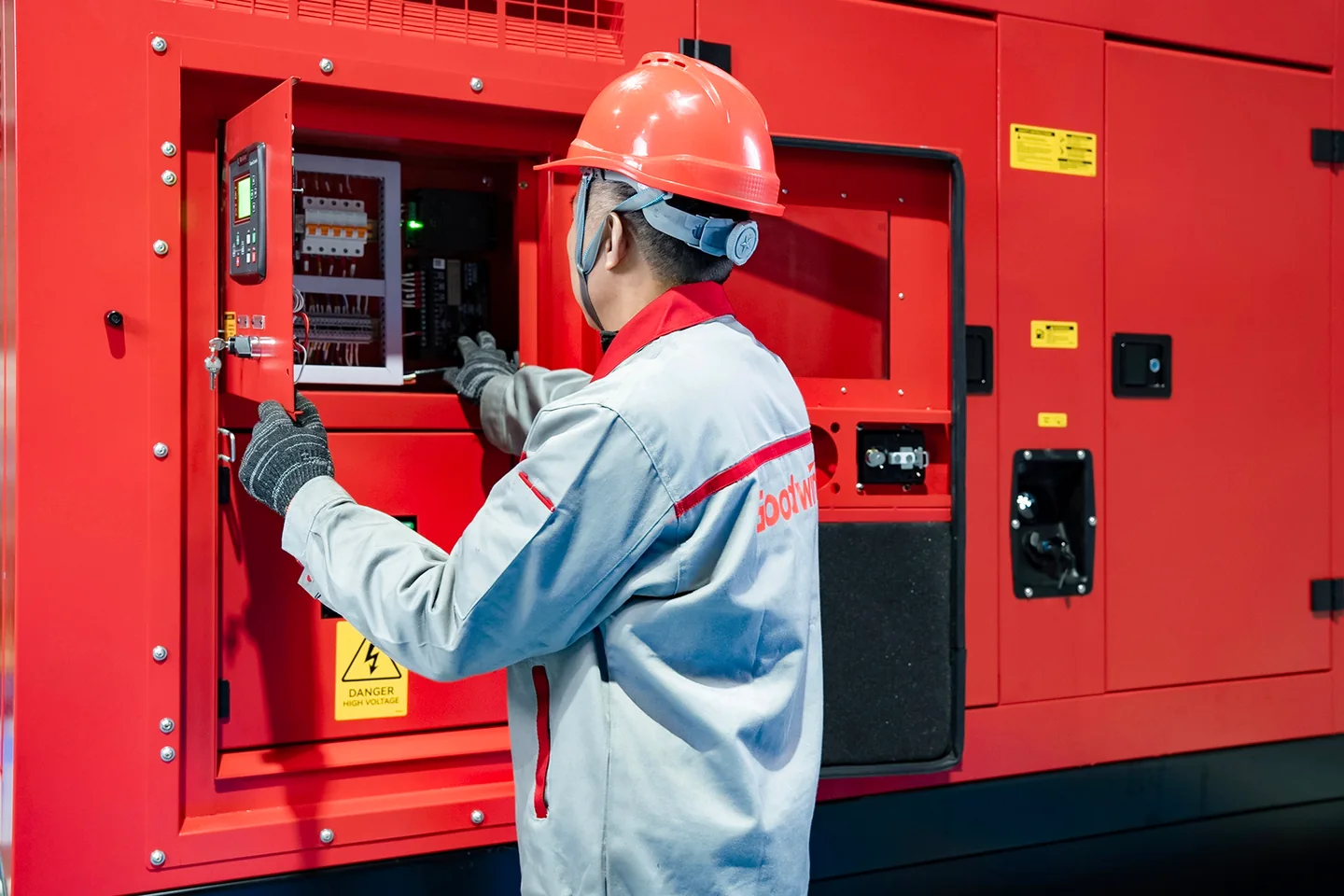
For a food-service project in Beijing, we delivered two containerized diesel generator sets rated at 750 kW each. Both passed the central kitchen’s acceptance process. If you are seeking a two-set quotation for a cold store, specify which rooms must keep running with one set out for service. That requirement determines how much capacity you need from each unit. Beijing central kitchen delivery
Fuel for an overnight outage
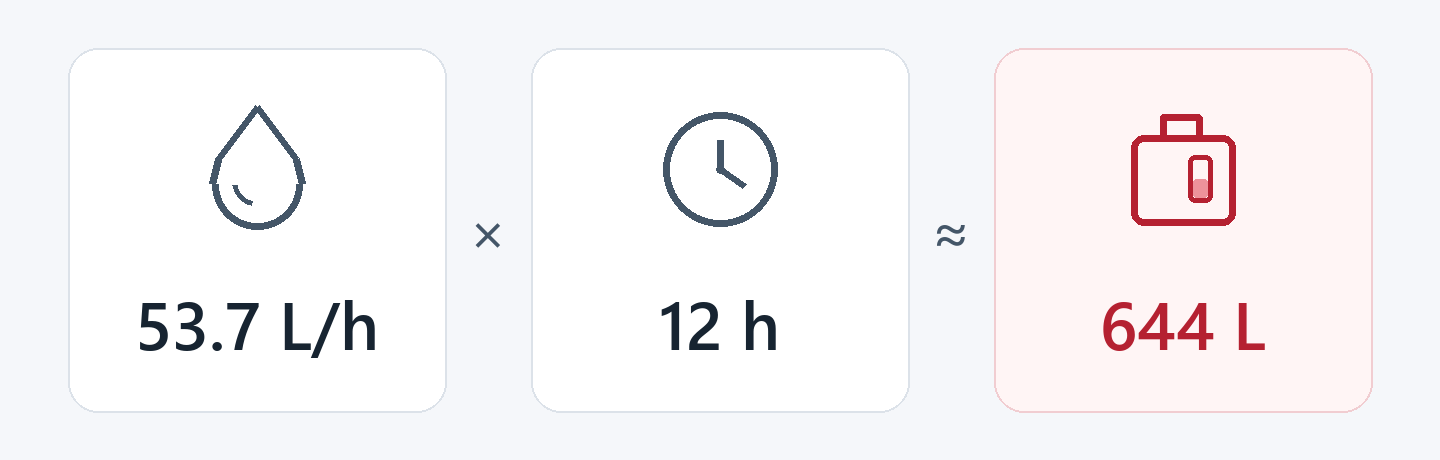
Ask the fuel supplier when a truck can actually reach the tank if the power fails after the last delivery. For a store operating at a steady 210 kW, the GW-S375 sheet gives a useful reference point. It lists 53.7 L/h at 75% of prime power, which on this model is 210 kW. Twelve hours at that constant load would use about 644 L before any reserve. The two daily schedules above move between different loads. For those, request consumption at each load and add up the litres for the hours spent there.
What to send for a cold-storage generator quote
Send a marked-up single-line diagram and a load schedule with one row for each room or each shared power circuit feeding refrigeration equipment. Include the supply voltage and frequency, measured running kW and kVA, compressor starting data, and the loads the operator can postpone. Specify how long the site needs to run through a power cut, the expected annual run hours and the longest interval between fuel deliveries.
If all you have is a refrigeration contractor’s quote, start with its equipment list. Tell us whether the warehouse will keep receiving goods during a power cut and which rooms must come back first. That gives us a basis for identifying the missing electrical data before we propose a generator. Discuss your cold-storage load schedule with GOODWIND.