

















How do you estimate diesel generator runtime?
For a steady load, divide usable fuel in litres by fuel consumption in litres per hour at that load. For changing loads, calculate the fuel needed in each operating period and add the results. Use data for the specified model, frequency, rating and configuration.
GOODWIND’s recommendation: agree the load schedule, fuel-data reference and usable volume before comparing a supplier’s runtime claim.
1. Start with the operating schedule
A fuel budget begins with the electrical load in kW and the hours for which that load will run. A factory may retain only essential equipment during an outage. A construction site may have a busy daytime period followed by a much lighter overnight load. Those jobs need different fuel plans, even if the generator nameplates show the same capacity.
Divide the required operating window into realistic periods. For each one, record simultaneous demand, duration and any significant changes in equipment use. Measured demand records are useful; distinguish them from nameplate totals and estimates. Include the auxiliaries supplied by the generator and identify any demand already included in another equipment input figure.
Keep the operating duty with the schedule: prime, standby or another declared rating. Fuel arithmetic does not establish whether a set is correctly sized or permitted to carry that duty. Starting performance, site output and the manufacturer’s operating limits still need a separate review. Our diesel generator sizing guide explains those selection inputs.
2. What the GOODWIND GW-B440 specification tells you
The published GOODWIND GW-B440 specification, using the Baudouin 6M21G440/5 engine, illustrates why the rating and units belong beside every fuel figure.
GOODWIND GW-B440 specification, using the Baudouin 6M21G440/5 engine
| Field | Published value |
|---|---|
| Engine | Baudouin 6M21G440/5 |
| Frequency / speed | 50 Hz / 1,500 rpm |
| Prime electrical rating | 320 kW / 400 kVA |
| Standby electrical rating | 352 kW / 440 kVA |
| Fuel figure labelled 50% PRP | 197.1 g/kWh |
| Fuel figure labelled 75% PRP | 193.4 g/kWh |
| Fuel figure labelled 100% PRP | 195.1 g/kWh |
The fuel values retain the specification’s g/kWh units and PRP labels; they are not litres per hour, site measurements or an endurance guarantee. For an order, confirm the applicable fuel-data version and its power reference for the complete proposed configuration.
L/h describes a volume consumed in one hour at a stated operating point. g/kWh describes fuel mass per unit of work or energy at a specified measurement boundary. Establish whether that boundary is engine shaft output or generator electrical output. Converting a mass-based figure to L/h requires the matching power basis and fuel density; multiplying an engine figure by alternator kVA or an unrelated electrical kW value will not give a sound volume estimate.
When discussing our Baudouin-powered generator range, send the exact model and operating conditions. A catalogue fuel figure is the start of that discussion, rather than a substitute for the data needed for your quotation.
Baudouin-powered generator range
3. Compare fuel data at the same useful output
Check the actual electrical kW behind a percentage. Fifty per cent of a 320 kW rating is 160 kW; fifty per cent of a 200 kW rating is 100 kW. Those points represent different work. Comparing their L/h values alone would not tell you which proposal uses less fuel while supplying your site.
Ask for consumption at the operating points in your load schedule. Retain the frequency, speed, rating code, configuration and stated reference conditions with the figures. Confirm whether the data covers the complete set and its relevant auxiliaries, and whether the supplier declares a tolerance or an estimate. A 50 Hz table should not silently become a 60 Hz budget.
A full-load value also does not define the rest of the curve. Use the documented part-load points. Where a required point is absent, request suitable data or an agreed estimation method; keep that assumption visible. Do not extend a straight line to zero load or invent a 25% value by halving the 50% figure.
Put the same kW schedule in both suppliers’ comparison sheets. Check that each proposed set can perform the duty before comparing fuel totals. A quote for a lighter operating task may show a lower L/h without meeting the site’s actual demand.
If two quotes differ only slightly in fuel use, ask for the reference fuel properties, declared tolerance and whether each figure is typical or guaranteed. Rounded catalogue values on different bases may not support that ranking. Caterpillar’s discussion of volumetric fuel comparisons explains the effect of these conditions.
Caterpillar’s discussion of volumetric fuel comparisons
4. Build a segmented fuel budget
For each period, multiply the applicable L/h by its duration. Add the period totals to estimate the diesel required for the planned window.
Illustrative eight-hour calculation
The following 200 kW prime rating, load schedule and fuel rates are hypothetical calculation inputs. They are not GW-B440 specifications or GOODWIND test results. For a real project, replace them with the applicable model data and operating schedule.
| Period | Electrical load | Duration | Assumed fuel rate | Calculated fuel |
|---|---|---|---|---|
| 1 | 100 kW | 2 h | 28 L/h | 56 L |
| 2 | 150 kW | 4 h | 40 L/h | 160 L |
| 3 | 200 kW | 2 h | 52 L/h | 104 L |
| Total | 150 kW average | 8 h | 40 L/h average | 320 L |
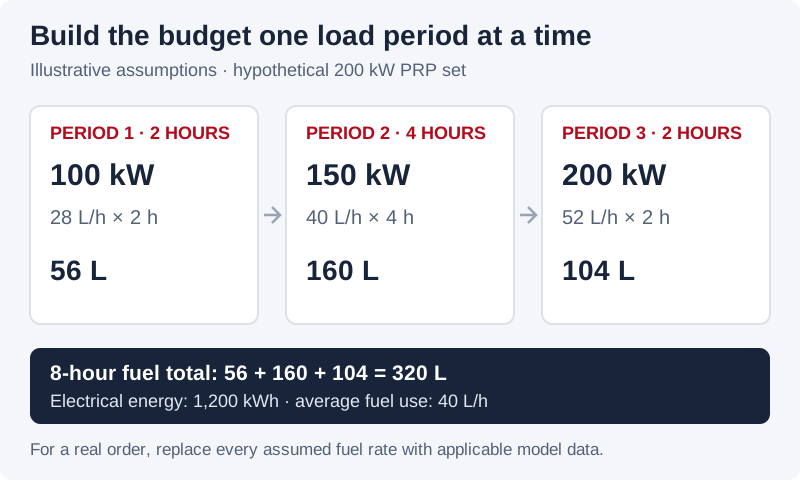
The electrical-energy total is 100 × 2 + 150 × 4 + 200 × 2 = 1,200 kWh. Fuel use is 28 × 2 + 40 × 4 + 52 × 2 = 320 L. The average fuel rate over these eight hours is 320 ÷ 8 = 40 L/h.
For a cost illustration, an assumed delivered diesel price of US$1.20/L would give 320 × 1.20 = US$384 for fuel in this window. Replace that price with the project’s actual purchasing and delivery basis. Record delivery charges separately if your fuel quotation does not include them.
5. Define the usable fuel window
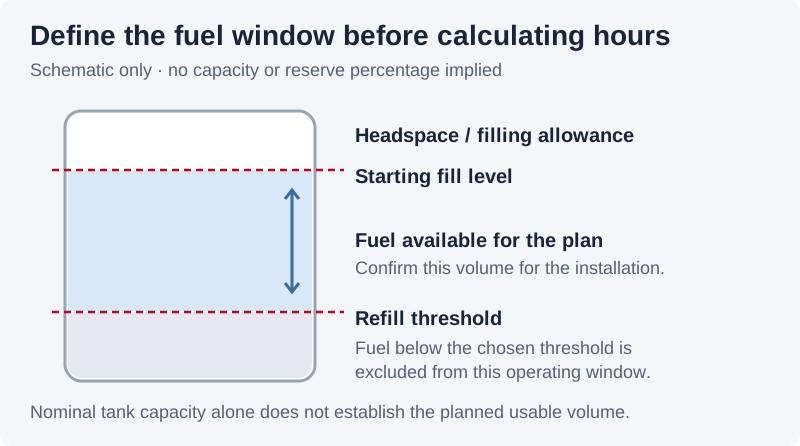
Ask which volume is available between the intended starting fill and the agreed refill threshold. A nominal tank label alone does not establish that quantity. The answer depends on the approved filling limit, fuel pickup arrangement, operating position and the project’s reserve and replenishment plan.
Keep the tank’s nominal capacity, permitted filling volume and planned usable amount as separate fields. The same GW-B440 specification lists a 700 L fuel tank in its silent-set table, but does not state the usable volume between operating levels. That entry by itself cannot establish a runtime. Tank selection and configuration must be confirmed for the actual order.

State when replenishment must start and how long fuel delivery or transfer can take. A refill alarm is useful only when the remaining fuel covers the agreed response window. Confirm who monitors the level, who arranges replenishment and how the supply remains available during the operating period.
6. Calculate runtime and the refill point
For a steady load, the runtime estimate is:
Estimated runtime (h) = confirmed usable fuel (L) ÷ fuel use at that load (L/h)
For a separate illustration, assume an agreed usable fuel volume of 400 L. At a steady 150 kW and the illustrative 40 L/h used above, the estimate is 400 ÷ 40 = 10 hours. Both the usable volume and fuel rate are assumptions here, not a tank specification or runtime promise for a GOODWIND model.
With changing loads, follow the sequence. In the eight-hour example, 400 L of assumed usable fuel would leave 80 L after the calculated 320 L consumption. If the next period stays at 150 kW and 40 L/h, that remainder covers two more hours. If it rises to 200 kW and 52 L/h, it covers approximately 1.54 hours. An eight-hour average cannot predict the next period without knowing its load.
Include the supplier’s declared fuel-data tolerance and a project-appropriate allowance for uncertainty. Set the refill action early enough for the agreed logistics; do not plan routine operation around emptying the tank. Required maintenance, permitted duty, cooling conditions and fuel-system limitations also affect how the installation can operate.
7. Separate fuel consumption from supply flow
The fuel used for a budget and the flow used to design the supply system answer different questions. Some diesel systems circulate more fuel through the engine than they burn, returning the remainder. Transfer equipment and supply/return pipework therefore need the selected engine’s fuel-system requirements, as well as the installation layout.
Use net fuel consumption for the burn-rate budget. Ask the responsible designer to use the applicable supply and return flows, inlet restrictions, return backpressure and other manufacturer limits when assessing the fuel system. A pump capacity should not be substituted for L/h consumed, and a consumption figure should not be treated as the required pump capacity. The Cummins liquid-cooled generator application manual, mechanical-design fuel-system section, explains this distinction.
Cummins liquid-cooled generator application manual, mechanical-design fuel-system section
8. Turn the runtime target into a comparable enquiry
“We need 24-hour operation” becomes useful when the enquiry also defines the electrical demand, permissible duty, fuel available and replenishment arrangements. Give suppliers a shared schedule, then ask them to identify the data and assumptions behind their fuel plan.
| Provide with the enquiry | Confirm in the proposed solution |
|---|---|
| Application, destination, voltage and frequency | Exact generator, engine, rating and configuration |
| Actual kW demand and duration of each period | Applicable L/h values, source revision, reference conditions and tolerance |
| Required operating window and refill access | Tank arrangement, filling limit and usable volume between agreed levels |
| Fuel-delivery or transfer response time | Monitoring, refill trigger and responsibility for replenishment |
| Installation layout and any external fuel system | Supply/return requirements and design responsibilities |
Compare the fuel budget together with the complete supply scope. Our generator quotation checklist helps keep accessories, installation interfaces and delivery responsibilities visible.
Send GOODWIND your load schedule, required operating hours, destination and refuelling window. Add the proposed model or power range, any existing tank details and limits on fuel delivery or transfer. These inputs let us discuss the configuration and fuel-data requirements against the job you need the generator to do.
Contact GOODWIND to discuss the generator configuration and fuel data for your project.
9. Fuel and runtime questions buyers ask
How much diesel does a 100 kW generator consume per hour?
There is no single L/h value for every 100 kW set. Identify the exact model, frequency, rating and actual load, then use its applicable consumption data. Also establish whether “100 kW” describes the generator’s capacity or the load it will supply.
What if the fuel table does not include my operating load?
Request the relevant part-load data or an agreed estimation method. Keep an estimated point separate from a published one. Where long light-load periods are expected, review the selected engine’s operating and maintenance requirements with the supplier.
Does a larger fuel tank guarantee longer uninterrupted operation?
It can increase available fuel, subject to the installation’s usable volume and fuel-system requirements. The operating plan must still satisfy the set’s duty limits, maintenance needs and site conditions. Define fuel autonomy as part of the project specification, with its load basis and replenishment plan attached.
Specification and calculation sources
The GW-B440 entries above reproduce selected fields from the linked GOODWIND specification, pages 1–2. The separate 200 kW budget is an illustrative worksheet with assumed fuel rates and operating periods. It is not a measured product curve. Confirm the current, configuration-specific data when requesting a quotation.