

















1. Start with the jobs your fleet must serve
A construction customer may move a generator between projects, while a shutdown customer may leave it in one position for a week. Those jobs can share a power rating yet need different handling, access and service arrangements. List your recurring applications first, then record the actual electrical demand, running schedule and site constraints for each group.
Separate the working load from starting events and future possibilities. Ask which motors start together, which equipment has electronic inputs and which loads must remain connected during a change. Keep measured demand, customer estimates and equipment nameplate totals identifiable. For repeated job types, maintain a standard information sheet that the rental coordinator can complete before choosing a unit.
For an enquiry to GOODWIND, give each proposed fleet group a configuration reference. Use it for the electrical variant, output connections, included accessories and service documents. Standardise connectors and routine checks where they suit your market, and list any exceptions. This lets your purchasing and service teams see which units can share a process and which need separate instructions.
Review the GOODWIND generator sizing guide
2. Keep electrical variants and operating duties explicit
For each fleet group, specify voltage, frequency, phase arrangement, required electrical kW and the applicable rating. A machine suitable for one temporary job may be unsuitable for a different daily operating schedule. Keep the manufacturer’s duty limitations, site derating and planned maintenance with the configuration record. A standby label does not automatically establish suitability for sustained rental work.
Where customers require different voltages, ask for the approved alternator winding arrangement and the ratings available in each supported connection. The number of winding leads is only part of the answer. Reconnection can affect current, regulation, protection, sensing and the complete package configuration. Assign authorised personnel, instructions and verification records before offering a voltage-changing service.
Record the output connection arrangement as carefully as the voltage. Check terminal access, connector ratings, protective devices, cable entry and the space needed for the actual conductors. Decide which cables and distribution equipment belong to the rental package and which are supplied on site. Every deployment should identify the approved electrical variant before energisation.
3. Use the Honduras configuration as a bounded example
GOODWIND’s published Honduras rental project describes a 100 kW set with a Dongfeng Cummins 6BT5.9-G2 engine, specified at 60 Hz, 1,800 rpm and 120/208 V. Its alternator has 12 leads, with reconnection subject to permitted arrangements. These are details of that configuration, not universal electrical settings for a rental fleet.
The same article describes front and side forklift pockets, a reinforced base, and operating, connection and refuelling points grouped on one side. For a similar order, request the handling information for the delivered configuration, including allowable mass, fork positions and centre of gravity. Check those details against the equipment available at your depot and the sites you expect to serve.
For another destination, confirm the required voltage and frequency before carrying over any part of that specification. Then list the handling method, exposure conditions and service access needed for your jobs. Ask the quotation to identify each included feature and any separately priced option. The order should describe the unit your team will receive, including the approved electrical and transport configuration.
Read the GOODWIND 100 kW Honduras rental configuration
4. Agree handling and site access before ordering
A fleet moves between storage, transport and operating positions. Describe every stage to the supplier, including lifting, loading, unloading and positioning. Request the package mass, dimensions, centre-of-gravity information and approved handling instructions that apply to the selected configuration. Check the available equipment and route at both the depot and expected sites before treating a handling feature as usable.
A trailer is a separate procurement decision from an enclosed generator. Road use, towing limits, braking, registration, tyres and lighting depend on the trailer and local requirements. State whether the unit will travel on public roads, move only within a site or be carried on another vehicle. Confirm the complete transport arrangement with the responsible supplier and local operator.
At the operating location, preserve access for cooling air, exhaust discharge, electrical work and routine servicing. A compact enclosure may still require substantial working space around it. Ask for the configuration-specific installation information and consider how barriers, stored materials or temporary structures could obstruct openings after deployment. Assign someone to approve the final position before operation.
5. Specify the service side and fuel plan
Identify the tasks the operator will perform during a rental: reading the panel, checking fluids, arranging refuelling and reporting alarms. Review which doors open, where cables leave and whether the fuel connection remains accessible with the intended installation. Grouping interfaces can help workflow, but the site must still preserve the clearance and separation required by the relevant instructions.
Build the fuel plan from the actual load schedule and applicable consumption data. Confirm usable fuel between agreed operating levels, the refill trigger and the expected response time. A nominal tank capacity does not define unattended operating hours. Decide who monitors the level and who arranges delivery, including access outside normal working hours if the rental job requires it.
For a mixed fleet, keep fuel records by unit and job. Differences between predicted and actual consumption can reflect changed loads, idling, operating time or measurement boundaries. Investigate the cause before changing a standard budget. Do not turn one customer’s experience into a guaranteed fuel figure for another engine, frequency or operating schedule.
6. Build the purchase matrix and handover record
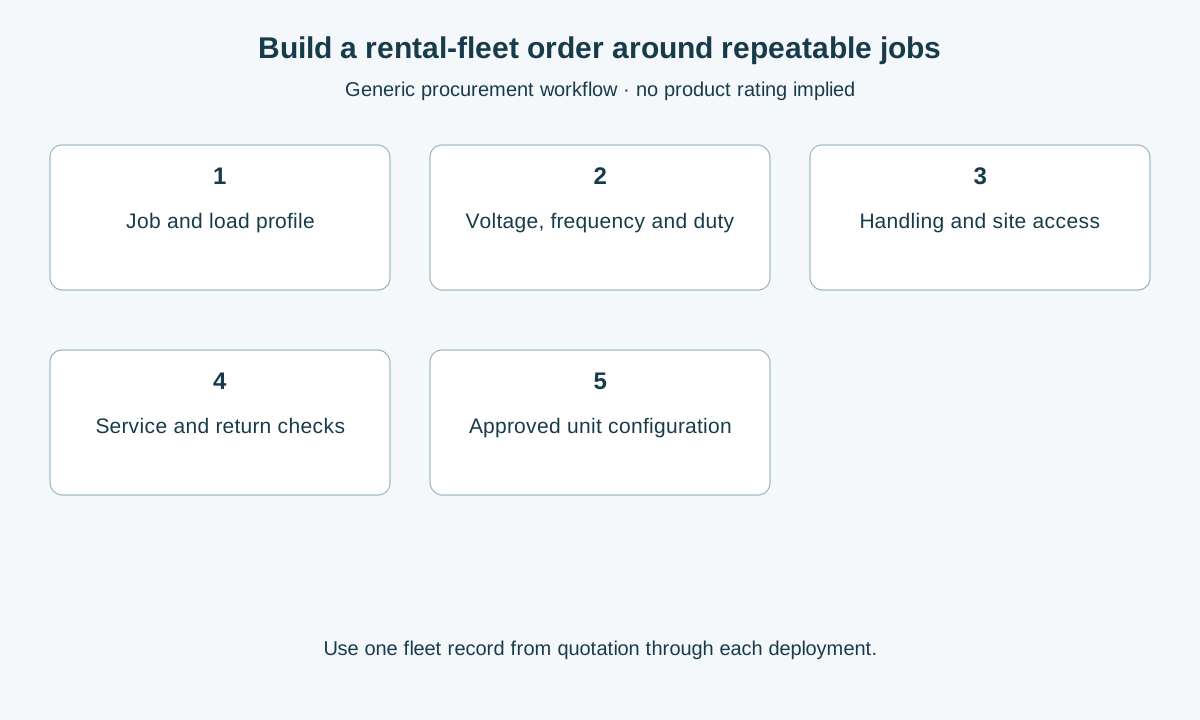
Give each proposed fleet configuration one controlled record. The record should connect the quoted unit to its electrical variant, installed components, documents and accessories. Use the same reference when comparing proposals, approving production and receiving equipment. When a component or arrangement changes, identify the affected drawing, service item and operating instruction before accepting the revision.
| Decision | Information to agree | Record to retain |
|---|---|---|
| Job coverage | Load profile, rating, voltage and frequency | Approved fleet configuration |
| Deployment | Transport, lifting and positioning method | Applicable handling instructions |
| Site interfaces | Cables, protection, airflow and exhaust | Installation and responsibility record |
| Fuel and service | Usable volume, refill and maintenance plan | Unit-specific operating documents |
| Return to depot | Condition, hours, alarms and outstanding defects | Return and release inspection record |
Agree the inspection and document requirements in the order. Ask which configuration checks, operating demonstrations and records will be provided, and identify any site-dependent work that remains. A factory record and a complete site installation answer different questions. Define who reviews the documents and closes discrepancies before the machine enters the available rental fleet.
Compare generator quotations and complete supply scope
7. Plan the return cycle as carefully as dispatch
When a unit returns, capture its identity, hours, location history, observed condition and reported faults. Reconcile cables, accessories and documents against the dispatch record. Separate normal scheduled work from unresolved defects, and prevent an incomplete repair from being treated as a routine turnaround. The next customer should receive a machine released against a recorded configuration and condition.
Build the service stock around the actual installed engine and package identities. Similar power ratings do not prove that filters, sensors or electrical parts are interchangeable. Keep the relevant manuals and approved references with the fleet register. Confirm technical support, training, warranty and replenishment terms in writing for the market and order; do not infer them from an engine logo.
8. Questions rental buyers ask
Should all units in a new rental fleet be the same size?
Choose the range from recurring jobs, operating profiles and support capacity. A narrow range can simplify some processes, while several sizes may fit demand more closely. Compare the operational and stocking consequences against real enquiries. Neither the lowest purchase price nor the largest available rating determines the right fleet mix by itself.
What should be checked after changing a unit’s electrical configuration?
Use the approved connection and setting information for the resulting configuration. Have the authorised technician complete the required verification, and update the unit record before its next hire. The dispatch team should be able to identify the current voltage, permitted output, connections and protection arrangement without relying on the settings used for the previous customer.
What information should come back with the generator after a hire?
Ask for operating hours, the customer’s load and refuelling records where available, alarm history and any reported damage or configuration change. Reconcile the accessories against the dispatch list. Keep an unresolved symptom visible in the return record so the person releasing the unit for its next job can see what still needs inspection or repair.
Compare the cost of adding a unit against the jobs you realistically expect to serve. Include transport, distribution accessories, inspections, planned maintenance and time unavailable between hires. Use your own records to estimate utilisation and turnaround time. If a proposed layout makes routine access harder, or needs a separate cable or lifting arrangement, include that work in the comparison rather than treating the purchase price as the complete cost.
Prepare your rental-fleet enquiry
Send GOODWIND the target market, typical customer jobs, expected load schedules, voltage and frequency, proposed quantities and operating duties. Add transport and handling methods, expected environments, service capability, fuel arrangements and package accessories. Ask for a configuration-by-configuration quotation with document and responsibility requirements. That gives both teams a practical basis for discussing a rental fleet your organisation can operate and support.
Discuss your rental-fleet generator requirements with GOODWIND