























Pump running load and starting kVA
A pump motor’s nameplate usually gives shaft power in kW. For the generator’s running load, use the electrical input at the pump’s duty point. Take it from a measurement or the manufacturer’s data, and record the current and power factor. On a separate line, enter the demand while the motor accelerates with the proposed starter settings and pump load.
A 55 kW pump motor on a 400 V supply
Take a three-phase motor rated at 55 kW shaft output. For this example, assume a rated running current of 105 A and a locked-rotor current of 600 A at 400 V. For a balanced three-phase supply, apparent power in kVA is √3 × line-to-line voltage × line current ÷ 1,000. At 400 V, that gives about 73 kVA at rated running current. At the instant of a direct-on-line start, the estimate is 416 kVA at locked rotor and rated voltage.
As the motor picks up speed, its current changes. The terminal voltage can also fall below 400 V. To use the 416 kVA estimate, the generator supplier needs the load already on the bus and the motor and pump torque curves. The motor must have enough torque to accelerate through the dip, and the equipment already running must stay online.
Restarting the pump or the compressor first
Check what the plant controls do when the supply transfers to the generator. A pump and a compressor can draw starting current at the same time if one is still accelerating when the other starts. Include the extraction fans, cooling systems and controls that stay on throughout the restart.
Suppose those essential loads draw 35 kW, the pump draws 60 kW once running, and the compressor draws 65 kW once loaded. If the pump is up to speed first, the compressor starts with 95 kW already online (35 + 60). If the compressor starts first and loads before the pump starts, the pump starts with 100 kW already online (35 + 65). These are the loads just before each start. To choose an order, compare what each motor draws as it accelerates and how long the process can wait for water or air.
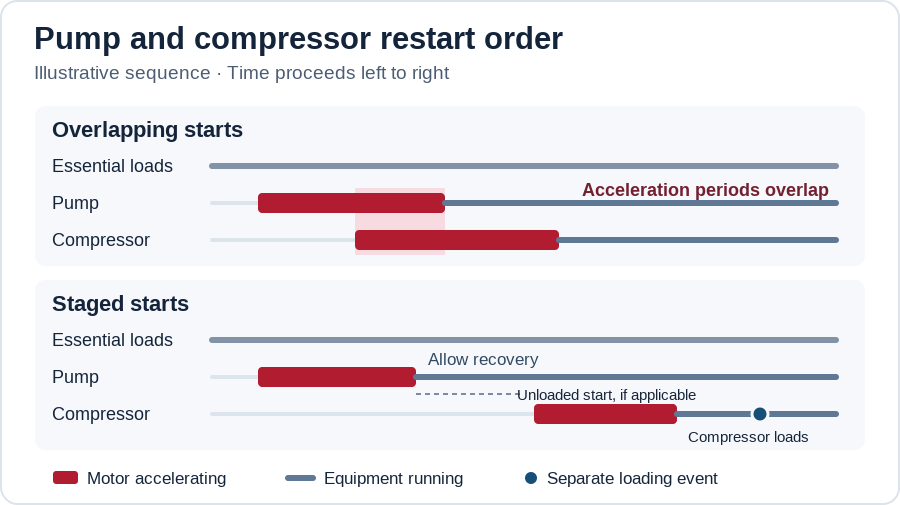
After a brief power cut, the compressor may still be under pressure. Ask the package supplier whether the controls confirm unloading before a restart and what pressure can remain. Use the starting-current data for that package and mode. If the controls permit a pressurised restart, include it. If the compressor starts unloaded, account for the separate increase in demand when it begins supplying air.
| Starting method | What the generator supplier needs |
|---|---|
| Direct-on-line (DOL) | Get the locked-rotor current at rated voltage, the acceleration time and the load already running. Check that the motor develops enough torque at the predicted terminal voltage. |
| Star–delta or soft starter | Get the starting current and required torque, plus the star–delta transition profile or the soft starter’s settings. Reducing voltage also reduces motor torque. Too low a current limit can keep a loaded pump or compressor from reaching speed. |
| Variable frequency drive (VFD) | Use the drive’s supply-side input data at energisation and during the acceleration ramp. Check how much voltage dip the drive can ride through, and request harmonic data where relevant. If a bypass can start the motor directly, size for that start as well. |
For a pump, confirm the head and valve position at restart. Agree the starter settings with both the equipment supplier and the generator supplier. Atlas Copco explains the torque available during a reduced-voltage start. For a drive-fed motor, see Danfoss on harmonics from AC drives.
Matching generator ratings to the running load
With the pump running and the compressor loaded, the plant in our example draws 160 kW. Assume its load schedule gives 190 kVA for that same operating point and calls for prime duty. Compare both figures with the prime (PRP) column. These three sets from our Baudouin diesel generator range are rated at 50 Hz, three-phase, 400/230 V. The data sheets give reference conditions of 100 kPa, 25 °C and 30% relative humidity.
| Generator model | Baudouin engine | Prime (PRP) | Standby (ESP) |
|---|---|---|---|
| GW-B165 | 6M11G165/5 | 120 kW / 150 kVA | 132 kW / 165 kVA |
| GW-B275 | 6M16G275/5 | 200 kW / 250 kVA | 220 kW / 275 kVA |
| GW-B440 | 6M21G440/5 | 320 kW / 400 kVA | 352 kW / 440 kVA |
The GW-B165 falls short on both kW and kVA. The GW-B275 and GW-B440 can carry that point on their published prime ratings. How long the plant draws 160 kW matters, too. The GW-B275 data sheet limits average output over 24 hours of continuous operation to 75% of its 200 kW prime rating, or 150 kW. If the plant draws 160 kW for all 24 hours, it exceeds that limit. If the demand varies, use the daily load profile to check the average.
Any set that meets the running-duty limits still needs a motor-starting check. The GW-B440’s 400 kVA prime rating describes running duty. The 416 kVA calculated for the example pump describes a locked rotor at nominal voltage. Comparing those two numbers alone cannot tell you whether the pump will reach speed or how far the voltage will dip.
Ask for the power available at your site altitude and maximum operating temperature. One buyer made the distinction explicit in a tender for an asphalt plant in Peru. The minimum was 500 kW prime at sea level. At the plant’s elevation of 4,000 metres, the set had to meet the plant’s actual demand. See the buyer’s clarification, item 19.
Once you have a site rating, check which alternator, excitation system, governor and controls the supplier has quoted. Our diesel generator sizing guide covers prime and standby duty, site conditions and the rest of the load list.
Voltage dip and recovery during a motor start
During acceleration, the alternator and excitation system support voltage. The engine and governor respond to the rise in real power. The pump may get up to speed while a contactor elsewhere drops out or a drive trips. For each load that must stay online, give the supplier the permitted voltage and frequency deviations and the time allowed for recovery.
For a critical start, ask the supplier to assess the quoted configuration with your motor’s start profile, the proposed restart order and the load already running. Ask for the sizing calculation, supporting transient data or an agreed test. A resistive load bank can show how the set responds to a step in kW. Agree what that test covers. On site, the motor draws starting kVA and must develop enough torque throughout acceleration, while the other equipment stays within its limits. The Cummins T-030 application manual explains voltage dip and acceleration and compares starting methods in Appendix §7.2.
If the tender calls for a performance class under ISO 8528-5, the class applies under defined conditions. Specify any project-specific restart separately. Give each bidder the same initial load, restart sequence and acceptance limits so you can compare bids and verify the result at the plant.
What to send for a generator quote
Give each motor its own row on the load list. Beside its running demand, note when the controls allow it to restart after an outage and what else will be drawing power at that moment.
| Item | Details to send |
|---|---|
| Motor and package | Pump or compressor model and motor nameplate. Include voltage, phase, frequency, shaft kW, running electrical input or running current and power factor, plus locked-rotor or starter data. |
| Mechanical conditions | Pump head and valve position, or compressor pressure and unloading status at restart. Give the expected acceleration time if known. |
| Restart order | Loads already online, the next motor to start, and any delays or interlocks. Flag motors that can start together and any drive bypass that can operate. |
| Site and acceptance limits | Location, altitude, operating temperature and prime or standby duty. Identify equipment that must stay on, its voltage and frequency limits, and the allowed recovery time. |
Before suggesting a larger generator, we look at whether the process allows the starts to be staggered or a different starter could reduce demand while still bringing the motor up to speed. We then check the proposed set against the site conditions and the loads that must stay online.
Replacement sets and missing motor data
Can I order the same kVA as the generator I’m replacing?
The old set’s rating and operating records are useful if you also know what has changed. Check the pumps, compressors and control settings. Even at the same kVA, the replacement may have a different alternator or governor. Have the supplier verify the most demanding start for the new configuration.
What if all I have is a motor nameplate photo?
Send us the nameplate photo with a note on when the motor starts and what is running at the time. If the plate omits locked-rotor current, ask the motor or package supplier for it. For a VFD start, ask for the drive’s supply-side input data at the planned acceleration settings. If you already have a motor list and restart sequence, include them with your enquiry.