

















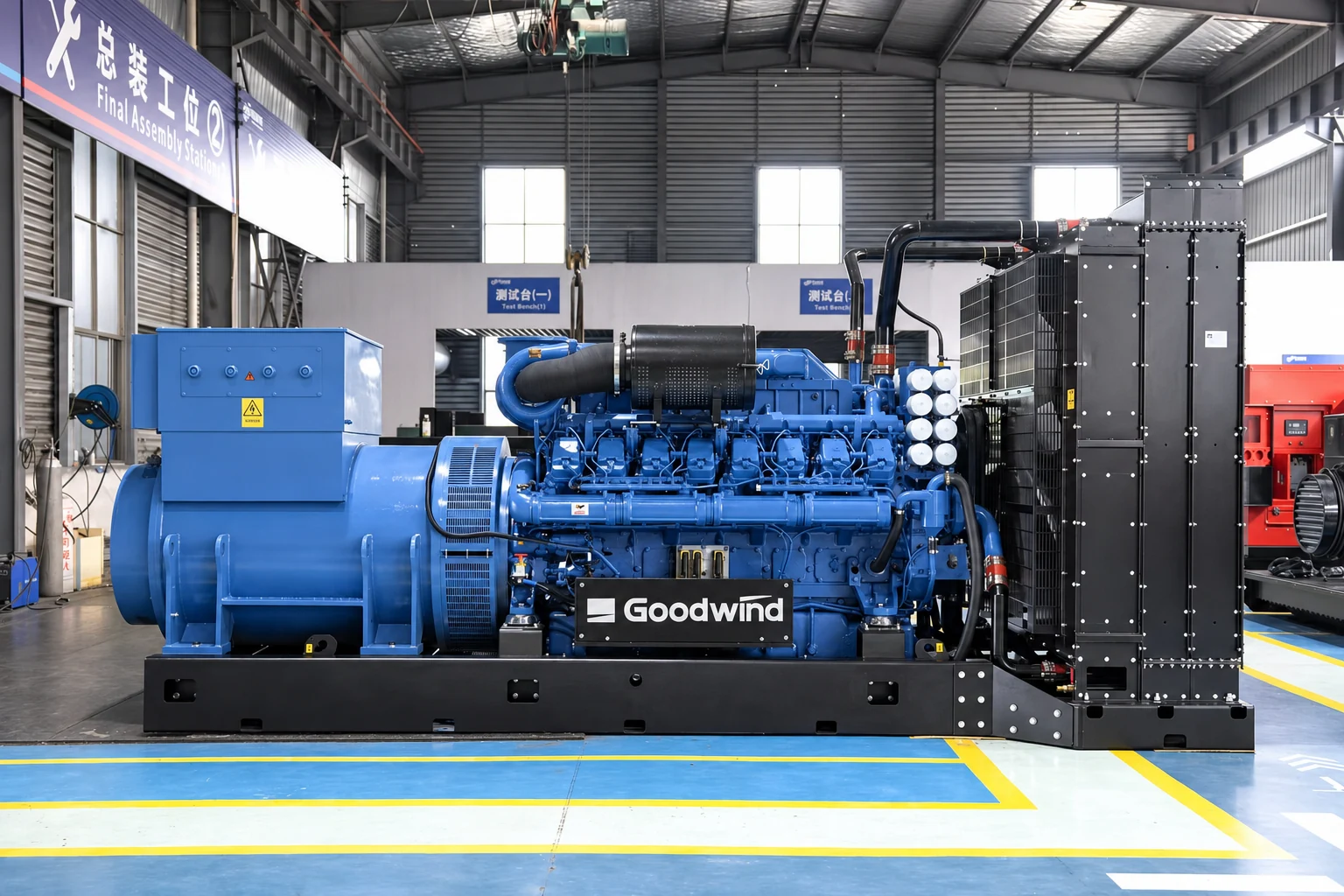
Put the exposure, component protection, cooling requirements, shutdown arrangements and maintenance responsibilities on the same specification. A canopy description or a single IP code leaves several of these questions unanswered.
The useful procurement question is how the offered package will manage your site's conditions throughout its working cycle. A filter may address airborne particles while adding airflow resistance. A heater may help protect stopped windings while depending on a separate power supply. These details belong in the quotation discussion, before the equipment layout is fixed.
1. Describe the exposure before choosing the protection
Start with the proposed location and operating pattern. State whether the set will sit in a building, under a shelter or outdoors, and identify nearby dust sources, seawater exposure and cleaning activities. Give the expected running hours and the length of periods when the generator will remain stopped.
For dust, describe the material and how it reaches the installation: windblown sand, vehicle traffic, processing equipment or other sources. Where available, provide particle and concentration data. If the site's assessment identifies combustible dust or a hazardous atmosphere, include that classification separately; an ordinary enclosure or filtration specification cannot settle those requirements.
| Exposure to describe | Useful project information | Question for the proposal |
|---|---|---|
| Dust and particles | Source, material, operating periods, wind direction and available measurements | Which intake paths need treatment, and how will collected material be serviced? |
| Moisture and condensation | Temperature and humidity range, rain, washdown, shutdown duration and auxiliary power | How will liquid ingress and internal condensation each be addressed? |
| Salt exposure | Location, shelter, prevailing winds, direct spray and experience with nearby equipment | Which surfaces and electrical parts need corrosion or contamination protection? |
A coastal address is a starting point. Photographs, a layout and a description of the actual exposure make it more useful. Include planned storage before installation, since the conditions during delivery and storage may differ from those during normal service.
2. Identify the component behind every protection claim
A complete diesel generator contains several protection boundaries: the alternator body, its terminal box, the control enclosure and the outer canopy or container. Ask suppliers to identify each boundary on the equipment schedule. A terminal-box rating does not establish the rating of the ventilated alternator around it.
The first numeral of an IP code concerns access and solid-object ingress; the second concerns water ingress under defined conditions. IP23 is not a dust-tight classification. STAMFORD | AvK's alternator IP protection guidance illustrates both the meaning of IP23 and differences between body and terminal-box ratings. It also explains that fitting a dry-dust filter does not automatically change the machine's IP code.
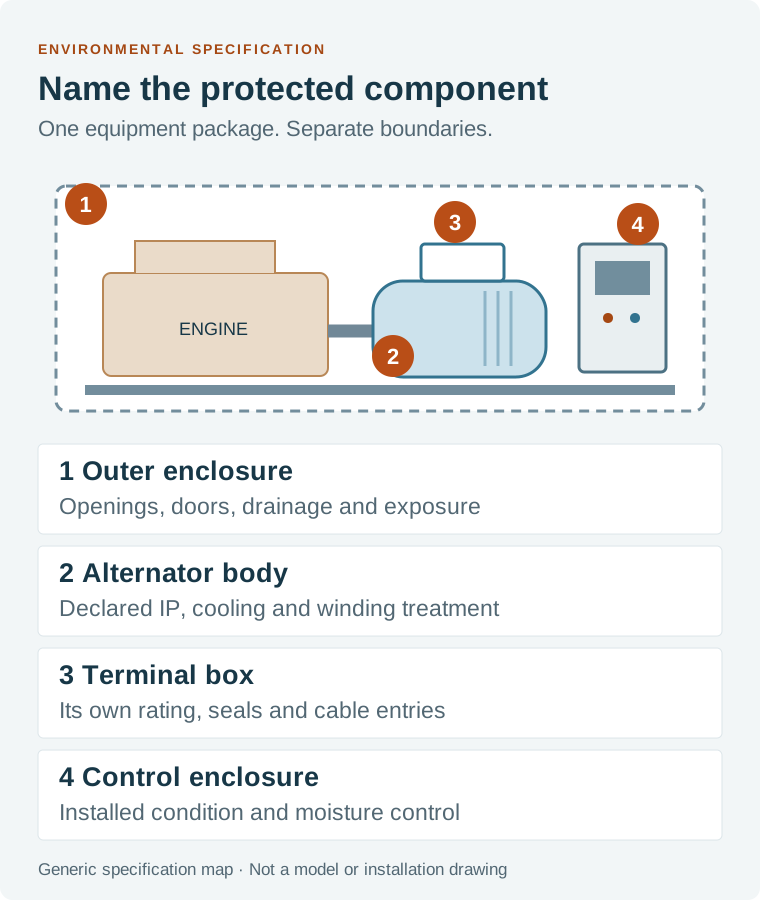
Keep ingress protection, insulation thermal class and corrosion treatment in separate specification fields. Class F or Class H describes thermal endurance; it does not establish salt-mist resistance. IEC 60085 addresses the thermal evaluation and classification of electrical insulation. Likewise, a quoted IP rating alone is insufficient evidence of corrosion resistance or control of condensation inside an enclosure.
Record the applicable standard and configuration beside each claim. Clarify the condition in which it applies: covers fitted, doors closed, cable entries completed and any required accessories installed. This makes responsibility for the finished installation visible when some work will be completed on site.
3. Plan dust filtration around the actual air systems
Engine combustion air
The engine's intake air cleaner serves a different duty from the openings that ventilate the generator enclosure. For heavy dust exposure, ask the engine supplier whether the proposed intake system needs a pre-cleaner, a different air-cleaner assembly or an alternative intake location.
Selection must account for airflow and intake restriction. Donaldson's pre-cleaner guidance explains that an undersized unit can impose excessive restriction. Request an assessment of the complete intake path, rather than accepting an additional filter simply because it is described as heavy duty.
Alternator cooling air and enclosure ventilation
Define the contaminant that each filter or separator is intended to remove. Dry-particle filtration and water-droplet separation are different functions. STAMFORD | AvK's air inlet filter guidance distinguishes the two and describes their effects on alternator cooling and rating. A device selected for one function should not be assumed to perform the other.
Where dust and wind-driven rain occur together, ask how water is kept out of the dry-filter medium and what happens if it becomes wet. Confirm drainage and inspection arrangements for that combined exposure.
Ask how technicians will reach the filters, inspect the radiator air side and clear collection or drainage points. Identify replaceable elements by part number and establish the service method for each. Instructions for a washable alternator filter do not establish a cleaning method for an engine air-cleaner element.
For engine filters, an appearance-based replacement rule can be misleading. Donaldson's servicing-by-restriction explanation links replacement to measured intake restriction. Agree the indicator, applicable engine limit and maintenance instructions for the supplied system. Build access and replacement availability into the purchase, alongside the initial filtration specification.

4. Account for moisture while running and while stopped
Liquid water entering through an opening and water condensing inside equipment require different assessments. Condensation can form when a surface is colder than the dew point of the surrounding air. Temperature changes and shutdown conditions therefore matter alongside the site's humidity figure.
STAMFORD | AvK's environmental conditions guidance discusses moisture risks, airflow management and drainage. For procurement, translate those issues into two reviews: how the installation limits incoming water, and how it manages moisture during stopped periods. Rain protection alone does not answer the second question.
Where alternator anti-condensation heaters are proposed, confirm their intended function, supply and controls. STAMFORD | AvK's anti-condensation heater guidance describes equipment intended to limit condensation while the alternator is stopped, with the heaters switched off during operation. These heaters are not a remedy for already wet windings.
The buyer's practical questions are whether auxiliary power is available during standby and storage, who supplies the circuit, and how heater operation is controlled in relation to generator operation. Request the manufacturer's arrangement and instructions. Keep engine coolant preheating and alternator anti-condensation heating as separate line items: they protect different parts and serve different purposes.
Include control enclosures and termination areas in the moisture review. Ask where water could collect, how drainage remains accessible and what inspection is required after prolonged storage or unusual water exposure. The handover package should identify the checks needed before the equipment returns to service; a general article cannot replace the selected equipment's procedure.
5. Specify corrosion protection beyond the outer paint
Salt exposure concerns both exterior materials and contamination inside the equipment. Deposits on electrical insulation can interact with moisture, so a specification covering only the visible canopy leaves part of the problem unresolved. The alternator supplier's environmental assessment should address the actual air entering the machine and its condition during shutdown.
For the enclosure, request a defined material and coating schedule. Useful fields include the substrate, surface preparation, coating system, specified film thickness and the treatment of cut edges, welds and repaired areas. Ask which items are covered by that schedule and how doors, fasteners, hinges and base structures are specified.
For the alternator, obtain the winding-treatment description applicable to the offered model. A statement such as “VPI treated” needs a defined scope: which assemblies receive which process, and what supporting documentation applies? STAMFORD | AvK's winding insulation guidance describes different treatment processes and the importance of contamination control. A process name by itself does not establish the environmental performance of the whole set.
Read salt-spray evidence with its test conditions
If a supplier provides a salt-spray report, check the tested specimen, substrate and coating, test method and edition, exposure duration and acceptance criteria. Establish how the specimen relates to the equipment being offered. A coated sample, a door assembly and a complete machine are different test subjects.
The official abstract for ISO 9227:2022 explains that salt-spray methods are not intended to predict long-term corrosion resistance. It also leaves product-specific exposure periods and interpretation to the relevant specifications. A stated number of test hours should therefore not be converted into a promise of years at a coastal site.
Complete the specification with inspection and repair instructions. Ask how transport damage is recorded and repaired, which cleaning methods are permitted and who supplies the approved repair materials. These details make the corrosion specification usable after delivery.
6. Verify cooling and available output for the complete package
Environmental protection changes must be included in the thermal assessment. Obtain the proposed airflow arrangement and identify the intake treatment, openings, ducts and discharge path. Confirm how the design prevents hot discharge air from returning to the intake.
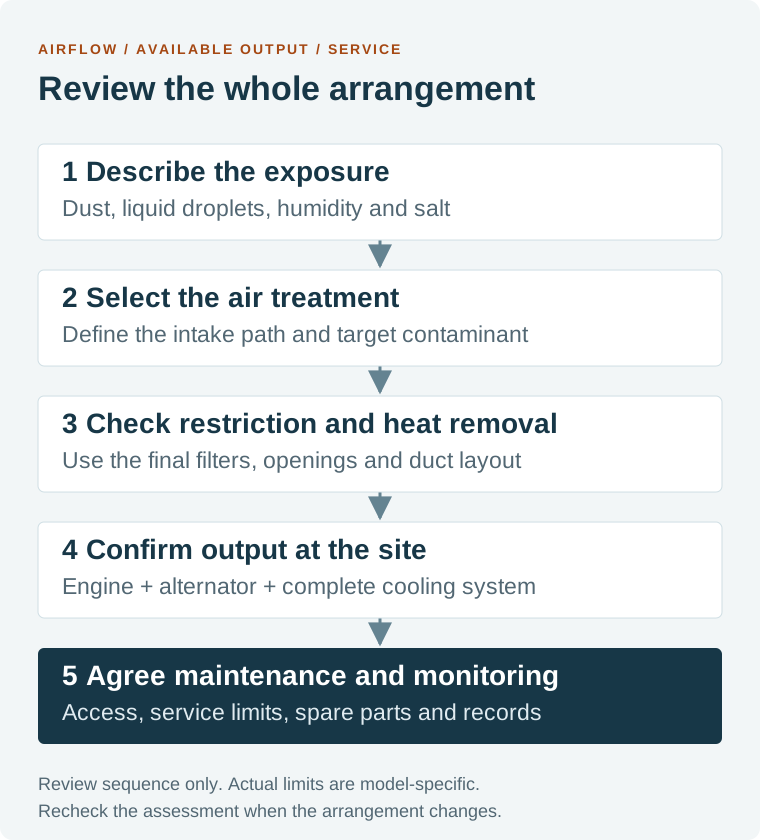
For alternator output, STAMFORD | AvK's environmental rating guidance explains why inlet-air temperature and altitude matter. In an enclosed set, the cooling air entering the alternator may be warmer than the outdoor air; confirm the temperature at that inlet. Ask for the electrical output available from the complete set at the specified duty, site conditions and final enclosure arrangement. The engine, alternator and cooling system each need an applicable assessment.
Request the assumptions for clean filters and the permitted service condition, together with any required output adjustment or monitoring. Avoid importing a single percentage from another alternator or treating a larger catalogue kVA as proof that the airflow problem has been resolved.
Our diesel generator sizing guide explains the load and rating inputs, while the open, silent and containerized generator guide covers the wider enclosure layout. Use the environmental review to refine the same project specification.
7. Compare complete environmental proposals
Illustrative procurement example
A coastal processing facility needs standby power. Its site brief identifies occasional process dust, wind-driven rain, long stopped periods and limited weekend maintenance access. Two offers quote the same electrical output.
One offer lists a weatherproof canopy, an IP-rated terminal box and an alternator heater. The second identifies each component's protection, the proposed air treatment, heater supply responsibilities, coating evidence and maintenance access. The first may still be suitable, but the available information is insufficient to compare the two on those requirements.
Return the same clarification schedule to both suppliers. Record the response, supporting document and remaining site responsibility against each item. This example does not select a model or establish a universal minimum IP rating.
| Comparison item | Evidence to request | Responsibility to settle |
|---|---|---|
| Component protection | Model-specific ratings and completed-entry requirements | Factory supply and site termination work |
| Filtration and cooling | Airflow arrangement, applicable restrictions and site output | Equipment package, room openings and ducts |
| Stopped-period protection | Heater specification, control arrangement and storage instructions | Auxiliary supply, operation and inspections |
| Corrosion protection | Material/coating schedule and relevant test evidence | Transport inspection, repairs and maintenance |
| Service access | Maintenance instructions, access drawing and replacement parts | Clearances, maintenance windows and local stock |
Carry unresolved items into the written clarification record. Once they are settled, retain the agreed revision with the order. Our generator quotation comparison guide covers the remaining configuration and supply-scope questions.
8. Prepare an enquiry that supports an environmental review
Send a compact site brief with the electrical requirements. The following information helps suppliers identify what is known, what needs assessment and which documents should support the quotation:
- Electrical duty: application, load information, required output and rating, voltage, frequency, phase and operating hours.
- Location and exposure: altitude, temperature and humidity range, indoor or outdoor position, dust sources, salt exposure and any direct spray or washdown.
- Layout: photographs or drawings showing openings, nearby equipment, airflow obstructions and maintenance space.
- Stopped periods: standby duration, storage arrangements and the available auxiliary electrical supply.
- Acceptance and maintenance: required supporting records, site responsibilities, access restrictions and planned service resources.
GOODWIND's canopy range provides a starting point for discussing enclosed configurations. Our Manufacturing & Quality page describes documented manufacturing and test capabilities. For an environmental specification, agree the particular configuration and evidence required for your order; a general factory test description does not establish a salt-mist or ingress-protection result.
Discuss your site's exposure with GOODWIND
Send your load and electrical requirements together with the dust, moisture and salt-exposure information available. Include the proposed layout and maintenance constraints so the configuration and outstanding technical questions can be reviewed together.
Send your project requirementsQuestions buyers often ask
Can an existing generator be moved to a harsher site?
Request a new application review using the installed component models and the new site conditions. Record any proposed enclosure or filtration changes, auxiliary supplies and revised maintenance needs. Suitability at the original site does not establish suitability at the next one.
What if the site's dust or humidity measurements are incomplete?
Provide what is available: source descriptions, operating schedules, photographs and experience with nearby equipment. Mark missing measurements explicitly and agree what must be obtained before the supplier can confirm the proposal. Avoid replacing unknown conditions with a generic “severe environment” label.
What should happen if a component changes before delivery?
Ask for the environmental review and supporting documents to be checked against the replacement model. Keep the agreed protection, airflow, output and maintenance requirements in the change record, as well as the electrical rating.